



Recent Comments
- ILRI Virtual Meetings » No travel required » Registration: How do I sign up? on Registration
- jenspeter on S2 – Q4 – Scenario 2, Question 4 (Livestock and Fish with a Global Animal Science Agenda – Theory of Change)
- Mblummel on S1 – Q1 – Scenario 1, Question 1 (Livestock and Fish like now – Key Research Areas)
- Mblummel on S1 – Q1 – Scenario 1, Question 1 (Livestock and Fish like now – Key Research Areas)
- Mblummel on S1 – Q1 – Scenario 1, Question 1 (Livestock and Fish like now – Key Research Areas)
L&F Yammer Group
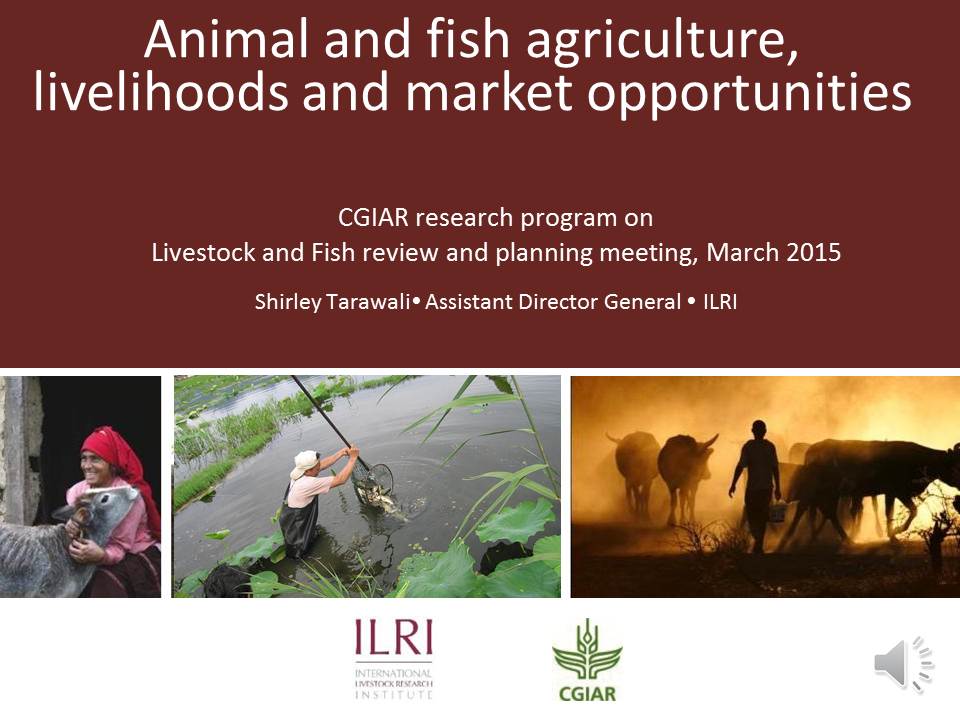
Day 2 Global review: Animal and fish agriculture, livelihoods and market opportunities
-
-
Presentation speakers
- Shirley Tarawali, Assistant Director General, Institutional Planning and Partnerships, ILRI
Click to watch the presentation by Shirley Tarawali
- What rings true or not?
- Is there anything missing?
- What do you find particularly important?
Comment at will in the comments section below.
Related Presentations
Nice presentation. very clearly makes the case for livestock production in the developing world. Really important to quantify who benefits from the growth? To what degree do we bring more ASF to poor people's plates? to what degree do the poorest gt more income from our interventions. Made me think that maybe we need to refine an earlier query: "Where does L&F has the most impact?" should be focused on the main target group of L&F: the poor with very limited access to ASF.
Good presentation, good to see livestock and fish well integrated, and some challenges thrown to the aquaculture teams!
Globally, there might be more poor consumers of livestock and fish (animal sources foods) than producers? What would a research agenda driven by poor consumers look like? How do we ensure our research investments reflects the challenges facing both poor consumers and producers?
Stuart - exactly why I raised this! For the 'bigger' L and F we need to think beyond 'intensification' and market engagement.....
Mike yes - the different scenarios for how demand might be met in a sense do factor in the consumer as a major factor here - consumer demand will be met one way or another - its business! If we dont do that via the smallholder sector then other ways will dominate (actually all and variations of all for sure will exist I imagine) with the challenges for those various livelihood dimensions as a result.....
And other value chain actors are often left out of the picture - traders, processors, retailers - many of whom are poor.
The fact that small holders remain important is critical to this debate. This creates opportunity and the imperative that we continue focus work here, at least for the livestock part of the work. (Fish has a different dynamic here).
I also like the observation that there are different potential trajectories to growth in supply for markets - ranging from intensification to the better management of extensive agriculture. I wonder if for this latter trajectory, the idea of intensification as extensification is a useful idea. Here, a "green economy" that strengthens basic human development in marginal areas, that enables home grown governance of range land resources and strengthens pastoralist resilience would enable a better environmental return on investment as well as an economic one. If we go for a wider CRP beyond small holder production intensification, these will be important things to grapple with.
Thanks Shirley for a well-balanced presentation across commodities. Demand for animal source foods will increase not least by growing middle classes with more purchasing power. This may well result in fish and livestock products becoming less affordable and accessible to the poor. In fact while per capita fish consumption is projected to increase globally, in Sub-Saharan Africa per capita fish consumption among the poor is predicted to decline in the coming decades, unless growth in the aquaculture (i.e. farmed fish as opposed to captured fish) sector can fill the gap.
PS: On a different note, slightly bemused by the title of the presentation: "Animal and fish agriculture...". A fish is of course an animal albeit a different animal :-)
Good points!
NB title - I was following instructions!!!
when we talk about livelihoods and market opportunities, it's also important we recognize that the 'livestock and fish' producers are a very heterogeneous group, in terms of gender, capacity, market orientation etc. The 'best bets' will have varied impact.
Thanks Shirley, great presentation. I like the thinking in terms of different trajectories for the development of the aquaculture sector. In broad terms the development of aquaculture in Asia and Africa are on completely different trajectories and we may need to think more explicitly about why they are different and how therefore to address issues in a different way.
Thank you for a very nice presentation. We need to think in terms of developing a sustainable small-scale production and improving the livelihood for these farmers just by minimizing the losses in the small scale production, identifying things that could be improved within these systems.
Thanks Shirley, very nice presentation
there is important node of fish value chain, retailers, this is the business of the poor women. they go for this job as last option for living. so aquaculture in Egypt played very important role in improving livelihood of those women through producing produce for them to sell and make living from .
Also liked your slide of exploring opportunities in aquaculture and add my voice to Froukje as opportunities in aquaculture sector may vary from Asia to Africa and even from country to country.
Nice presentation, Shirley. We appreciate the link to policies under the 'who is doing what' section. It may be useful also to bear in mind changing policies and trends related to gender and agriculture and how these are shaping market opportunities and livelihoods as well as research themes.
Very nice presentation Shirley. I continue to think that one of the real often overlooked opportunities is pig production. Sure some countries aren't interested due to religious reasons but among the very poor pigs offer a real way out of poverty and provide economic security.