



Recent Comments
- ILRI Virtual Meetings » No travel required » Registration: How do I sign up? on Registration
- jenspeter on S2 – Q4 – Scenario 2, Question 4 (Livestock and Fish with a Global Animal Science Agenda – Theory of Change)
- Mblummel on S1 – Q1 – Scenario 1, Question 1 (Livestock and Fish like now – Key Research Areas)
- Mblummel on S1 – Q1 – Scenario 1, Question 1 (Livestock and Fish like now – Key Research Areas)
- Mblummel on S1 – Q1 – Scenario 1, Question 1 (Livestock and Fish like now – Key Research Areas)
L&F Yammer Group
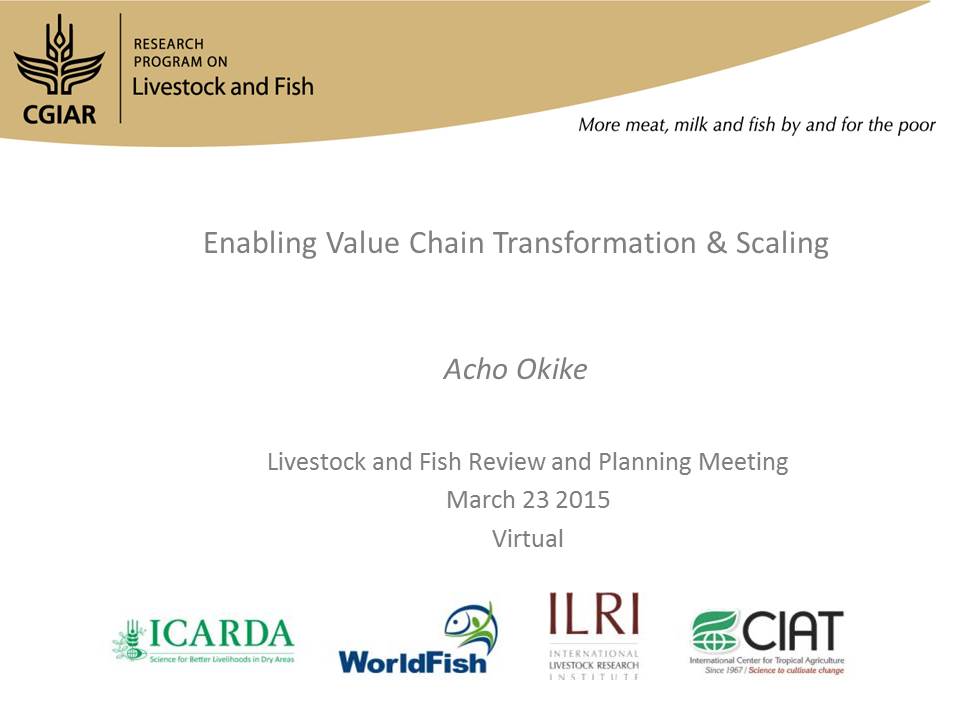
Day 1 FS review: Enabling Innovation for Value Chain Transformation and Scaling
-
-
Presentation speakers
- Acho Okike, Country Program Manager, Nigeria, ILRI
Please view this presentation and comment below:
- What in the presentation rings true or not?
- What is missing?
Return to Flagship Review Page
Flagship Changes
1. Value chain approach increasingly accepted as relevant and appropriate in the broad context of agriculture research for development program
2. Donors and partners warming up to the prospects of growing value chains by paying attention to pre-commercial smallholders (poor
women, men) and small scale entrepreneurs
3. Need for forming private public partnerships in a value chain framework
4. Systems thinking gaining prominence among researchers as more fitting to the addressing challenges faced by value chain stakeholders
5. Institutional and attitudinal changes taking place especially among policy makers demanding for CRP products in value chain countries
Related Presentations
Good overview. In the presentation there are various references to policy. However it would be good if we can outline how we are interacting with policy makers and what are the lessons. May be writing up some small stories/briefs?
I can give the example of Tanzania, where we're interacting with 'decision makers' at national (at the dairy development forum) and also at local levels. It's about understanding at what levels we need to engage, for what reason (not only for them to facilitate our data collection!) and how. We haven't yet seen the benefits but at local level, we've mapped the program activities and the local gov plans, so that we identify synergies and possibility of coordination.
Michael, here's a link to one recent study on the dairy development forum is facilitating communication and policy linkages: http://bit.ly/1N82zpu. This blog also highlights successes and challenges of emerging dairy innovation platforms that were facilitated by the MilkIT project at the local level:http://bit.ly/1HWCsRh. Further synthesis of what has happened to date was part of the focus of a recent workshop that will come up with briefs and other write-ups: http://milkit.wikispaces.com/writeshop.
What indications so far do we have that scale is likely to follow on? Any early indications that we are on the right track here?
Stuart, For most value chains, especially those starting afresh, it is too early to show any evidence that scale will follow. However, for legacy project e.g. the fish value chain in Egypt, there is already some thinking of geographical scaling to Ghana.
And in terms of early indications, I mentioned the case of Bangladesh where improved nutrition security among rural and urban poor has been linked to the involvement of poor people and small scale enterprises in growing fish production/productivity. That is an evidence that the participation of poor people in increasing ASF production could lead the increased consumption of ASF by the poor.
Playing catch up here (due in part to time differences). Thank you for the presentation Acho and for keeping fish on the agenda. The examples given re. fish and scale (;-)) build in part on legacy work, illustrating the importance of providing sufficient time for our R4D experiment. They also build in part on good development work/projects around which we wrap research to help ensure quality and create the evidence.
The ToC we're developing for Tanzania is being designed to pave this track and hope it will get us there
I am not convinced that value chains is as persistent an idea as the presentation makes out. The comment that systems thinking is gaining ground is true, and has coupled with value chain thinking so far to give rise to the interesting variant models M4P.
If this is correct, do we need to rethink the way in which we look at value chains rather as complex livestock systems? Would this enable us to think more out of the box in terms of achieving system transformation? There is something within traditional value chain thinking that is counter entrepreneurial and makes us design steps within predetermined pathways, when in fact we deal with unpredictability.
thanks Stuart, and realising that complexity, as for example, in developing the ToC at VC level, is a first important step. The next question is whether we have the skills and expertise to move to that level of engagement?
Quite a bit of thinking around this has been going on in SASI as well - check e.g. http://livestock-fish.wikispaces.com/Workshop+Report
Just an observation, the SASI seems to profile themselves mostly at the 'long-term' and 'strategic' level while for the VC approach the main focus seems to be on the (poor) stakeholder at the beginning of the VC. At the same time I am missing a link that puts the outcomes from the three 'technical' flagships into added value at the producers' level.
As a first impression, it seems as if the flagships are still too much operating within their own domain. This may simply be a consequence of the way things are presented and maybe they are very well connected in reality. So far I am missing a true integration or synthesis of the L&F program.
Hi Dirk - there are many examples of outputs of technical flagships being used in the value chains, however these weren't well high-lighted in the presentations. As an example, in case of genetics we have development of upstream technologies based on needs of specific value chain (e.g. cold chain free artificial insemination), as well as geneticists working directly within the value chains (e.g. I work directly with the Vietnam and Uganda VC teams to assess genetic issues / test interventions etc.). Where I feel we are less strong is collaboration between the flagships on animal production i.e. health, feed, genetics) at the level of upstream research,
Thanks Acho! You indicted that there is increased emphasis on public / private partnerships, and certainly I agree. Do you think we have sufficient capacity within the CRP itself, or through or our partner networks, to successful engage here? I would be very interested in attending a training course on this area - any others?
Hi Karen - I doubt that we have the internal capacity to engage here. This need was identified by development partners.
Thanks Karen, Good to read there are several good examples. I think these are the successes we need to hear about: less of the broad brush jargon :-)
I agree with the concern put forward by Dirk Jan and mitigated by Karen about the relationship between FS and VC. Of course it is hard to find the perfect balance/degree of resolution in these brief presentations. Still, I think, for the forthcoming discussion on phase 2 we need to look more into the facts/evidence for assess how to move forward in the best way….
I agree with both of you Ulf and Dirk. Efforts are on-going to further clarify these relationships including between VCTS and SASI. It is important to already have this clarity before phase 2.
I presume that we could extend definition of enabling innovation for value chain transformation and scaling, given at the start of the presentation (as‘enabling new knowledge to be used in new ways’) to enabling existing technologies to be used in new ways, or increasing access to existing technologies. Do you feel we have expended sufficient resources on exploring these opportunities?
Sure Karen - "enabling the use of existing and new knowledge/technologies in new ways" will improve the thinking.
Thank you, Acho, for a comprehensive presentation of the work that we do at the VC level.
It would also be nice to showcase in future presentations some concrete examples of how work in the technology flagships are being captured and/or being grounded to the real context of the VCs and bring about the desired outcomes as envisioned by the program, and also how VC work may have shaped the research priorities of the technology flagships. We have done much better in the recent past to get past the disciplinary silos and the program deserves credit in 'forcing' us to do so.
Dera Lucy. I agree with you that concrete examples between FS and VC would further enhance this interesting presentation.
Lucy - Thanks for this. sometimes one is constrained by space specifications and fail to list concrete examples which by the way are many. The fact, as I increasingly realize, is that the more we believe in the value chain approach the more we see that a systems thinking way of doing things is inevitable and the more we rally with other disciplines to solve the problems of VC stakeholders - which in themselves are interwoven. I tried to make this point in the opening slide on changes that are occurring.
A good presentation. For what it is worth, I think one of the most important research contributions that VCTS could make is to take a comparative approach to learning across VCs with the same commodity focus. More cross VC learning would greatly contribute to the generation of IPGs and avoid potential duplication.
Great idea! But is this a task for SASI/VCTS or both?
Thanks Keith. I understand this would be part of the work that SASI does: a meta analysis across value chains or commodities for systemic learning. The information used by SASI would however, be generated by assessments done on specific projects and VCs in the VCTS flagship.
In relation to the selection of our value chains … are there any plans to revisit value chain selection, whether we made the right choices, should all be retained moving forward etc. What about addition of new value chains?
Karen, excellent question. In the original proposal, we had anticipated that one of the roles of Targeting (now part of SASI) would be to 'validate' the selection of value chains -- that we would have been doing the kind of trend and policy analysis that would prove or disprove the potential for our selected value chains to grow and contribute to food security in their regions as we outlined in the business cases we presented in the proposal. We haven't been able to get any work going on this and so needs to be recognized as a critical gap.
Should we consider adding new value chains? When this question comes up, the answer is usually: 'are we satisfied that we are delivering on our initial set?' And there it is obvious that we have not, and we will certainly want to review our current selection and consider whether we should close some down and focus on fully delivering on those where we are achieving momentum.
And should we consider expanding the systems portfolio to include smallholder beef cattle and poultry? This is certainly possible and would depend on developing a convincing business case that there is good potential for developing inclusive value chains that address national food security and that our research can contribute to. And I'm happy to discuss these!
This would be very interesting indeed. From a gender perspective, it would be useful to assess the role of different livestock species VCs via-a-vis empowerment or gender equity. It would also be interesting to assess the complementarity among livestock value chains to understand, for example, how involvement in smaller livestock VCs can be a first step for the most poor to build resources to then participate in larger livestock (or larger revenue-generating) VCs. We are exploring options to undertake the latter research in TZ.
Can you expand on the links between VCT and SASI …. I see a lot of potential for collaboration here but am not clear on where this is being realized.
interesting that no one is answering this question... There are actually plenty of collaboration, the same way the technology flagships interacts with VCTS. On gender, nutrition, VC upgrading etc. And a lot of staff are both on SASI and VCTS. So for example, Emily is working on SASI when developing VC upgrading approaches and she 'tests' them in Uganda.
We in Addis (Peter, Alan, Barbara, Barbara, Girma, Aynalem, Jane, Jerome) also wonder about the link between VCTS and SASI. The conceptual stuff seems to sit in SASI and the practical stuff in VCTS - but by having them in separate flagships some of the links along this continuum are lost. There is a case for merging these flagships.
An, Mats, Keith and I have presented to Tom about seven (7) possible configurations of SASI and VCTS with pros and cons. I think that the PPMC may already be reading the document.
and "merging of the two flagships" is one of the alternatives. Other alternatives include: - lifting out Innovation Systems research from SASI and make that whole research agenda (conceptual And practical) core to VCTS ; - strenghtening the research on business models; - ..
but yes, currently a lot of the conceptual work in SASI, inclusive the "diagnosis" (the assessments that used to be housed in VCD) and the "design of integrated packages" -- the actual tesing than moves to VCTS...
I note, as I think others have that 'innovations' seems to appear also in SASI!
A question on the reference to knowledge 'generated' - to what extent does all knowledge have to be generated by the program/flagship as opposed to using existing knowledge - perhaps in new ways, which could include things like combining technological solutions........
Thanks Acho for the presentation.
In your opinion, do you think ICT (especially mobile phones) can be leveraged to transmit knowledge and research outputs in this value chain?
In the innovation track under the genetics flagship, advancements in ICT and especially the use of mobile phone has been identified as one of ways that can be used in data collection as well as dissemination of information. As Kingbred 23 and Stuart commented under the animal genetics presentation, http://livestockandfish.ws/?presentation=animal-genetics&cpage=1, the use of ICTs can be used to learn more of what the farmer wants and also be used to bring the farmer closer to the conversation and I think this might be applied across the flagships.
Very Good presentation Acho
what di you mean by Systems Thinking?
Building partnership between public and private sector is very important to create sector devlopment